The Intelligence of Stability
e often measure physical fitness by what can be seen or counted: the weight lifted, the muscle gained, the kilometres completed. Yet one of the body’s most important abilities is far less visible. It is the capacity to remain controlled when movement becomes unpredictable.
A person may be strong, exercise regularly and have an athletic physique, yet still struggle to control the body effectively in motion. How quickly can you recover if your foot slips? Can you keep your trunk steady while standing on one leg? When climbing stairs, rising from a chair or carrying something heavy, does your body remain aligned, or does it lean, rotate or shift unnecessarily?
These small moments reveal something strength alone cannot fully capture: stability.
WHAT IS STABILITY?
In simple terms, stability is the body’s ability to control the joints and trunk during movement. It allows us to maintain alignment, respond to change and regulate force without unnecessary motion.
Stability does not depend on muscles alone. It relies on continuous communication between the brain, nervous system, joints, muscles, vision, inner ear and sensory receptors throughout the body. At every moment, the body is receiving information about where it is in space, whether the surface beneath it is firm or uneven, how weight is distributed and whether balance is beginning to shift.
The nervous system interprets this information and activates the appropriate muscles, ideally with the right amount of force and at precisely the right time.
This is why stability training is more sophisticated than simply standing on a balance board. Its purpose is to help the body become more controlled, coordinated and adaptable when movement conditions change.
Research suggests that unstable surfaces and asymmetrical loading may increase activation in certain stabilising muscles. Greater instability, however, does not automatically make an exercise more effective.
“True strength is the ability to control force at the right moment, in the right direction and with the intelligence to adapt.”
INSTABILITY IS A TOOL, NOT THE GOAL
BOSU balls, balance pads and other unstable surfaces have become familiar features of modern gyms. Used appropriately, they can be valuable, although instability should never be introduced simply to make an exercise appear more advanced.
As instability increases, the body may recruit more muscles to maintain control. At the same time, its ability to produce maximum force often decreases. Performing a heavy squat on an unstable surface, for example, is not necessarily more effective than squatting on stable ground. If the goal is maximal strength, a secure surface will usually allow a person to lift more safely and generate greater force.
If the objective is to improve balance, coordination, joint control or the responsiveness of stabilising muscles, carefully introduced instability can be highly beneficial. The key is to match the exercise to the intended outcome.
Instability also does not need to come from the floor. It can be created by the way a load is carried. Holding a weight on one side of the body forces the trunk to resist leaning and rotation. A suitcase carry may look simple, yet it places meaningful demand on the abdominal muscles, back, hips and pelvis.
The body must continually organise itself around an uneven force. This is a practical form of stability training because daily life is rarely perfectly symmetrical.
WHY STABILITY MATTERS
The body needs to do more than produce force. It must also be able to control it.
This principle is particularly important in functional movement and rehabilitation. Properly designed balance and stability exercises may be useful for people experiencing balance deficits, chronic ankle instability or certain forms of lower back dysfunction.
Consider someone who repeatedly sprains an ankle. Strengthening the muscles of the leg may help, but strength alone may not resolve the problem. The nervous system must also be able to perceive the position of the foot and ankle, recognise when balance is being lost and activate the correct muscles quickly enough to restore control.
This awareness of the body’s position and movement is known as proprioception. It is one of the foundations of stability.
The same principle applies to the spine. Strong abdominal or back muscles do not automatically guarantee good trunk control. Those muscles must coordinate with one another to resist unwanted movement while the arms and legs are moving or carrying a load.
Stability becomes increasingly important with age. A loss of balance, coordination or reaction speed can gradually reduce confidence in everyday movement. A person may begin to avoid stairs, uneven ground or longer walks because they no longer trust how their body will respond.
Training balance and stability alongside muscular strength can therefore support independence, confidence and quality of life.
TRAIN ONE SIDE AT A TIME
One of the simplest ways to develop stability requires no specialised equipment: perform certain movements with one side of the body at a time.
Changing a two legged exercise into a single leg movement, or a two arm exercise into a single arm variation, significantly increases the body’s need to stabilise.
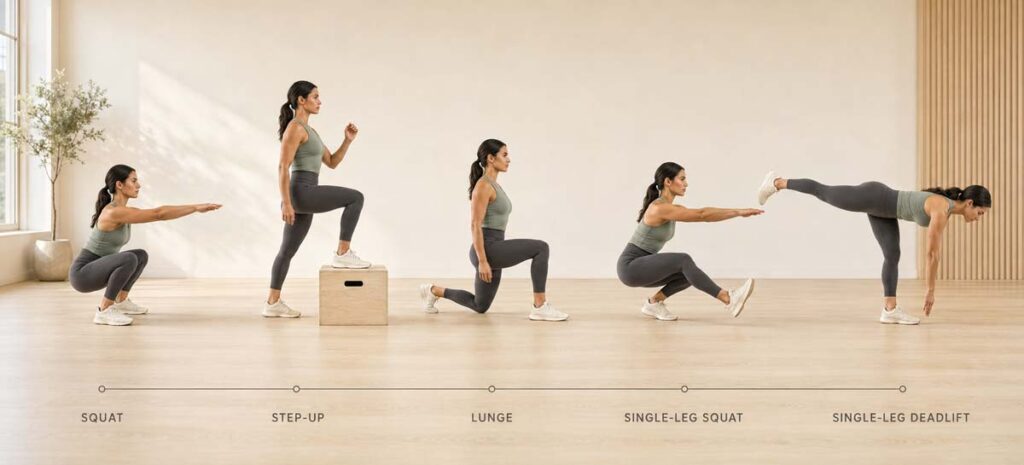
A lower body progression might move through the following stages:
Squat → Step Up → Lunge → Single Leg Squat → Single Leg Deadlift
As movements become more unilateral, the gluteal muscles, trunk and smaller stabilising structures must work harder to maintain alignment.
The single leg deadlift is a good example. It strengthens the hamstrings and gluteal muscles while also challenging balance, pelvic positioning and trunk control. The aim is not to reach the floor or lift the heaviest possible weight. The priority is to hinge from the hip without allowing the pelvis to rotate or the body to collapse out of alignment.
The same principle can be applied to a glute bridge. A standard bridge allows both legs to share the work. Lifting one foot from the floor increases the demand on the gluteus maximus and gluteus medius while challenging the muscles responsible for keeping the pelvis level.
A movement that appears simple can reveal meaningful differences between the two sides of the body.
RETHINKING THE CORE
When people hear the word core, they often think only of the visible abdominal muscles. In reality, the core is a coordinated system that includes muscles around the abdomen, spine, pelvis, hips and diaphragm.
One of its most important roles is to prevent unnecessary movement. While walking, lifting, running or carrying something, the trunk must often resist excessive extension, flexion, rotation or side bending. This is known as anti movement training: the body creates stability by controlling forces that would otherwise pull it out of position.
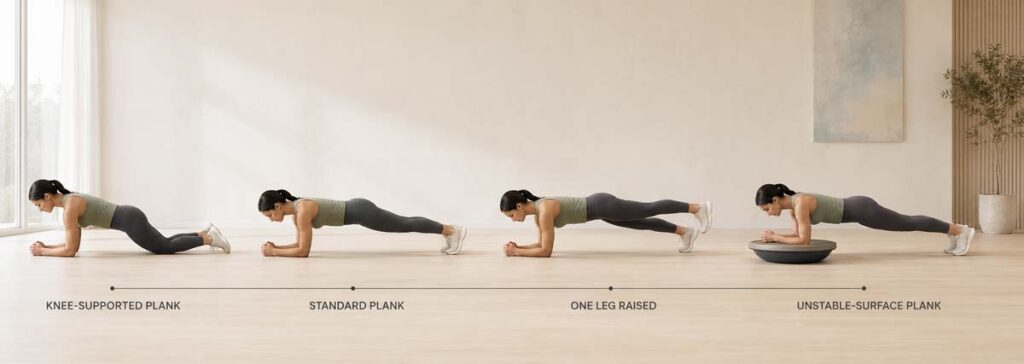
The plank is one of the simplest examples. Although the body appears still, the muscles are actively working to prevent the lower back from arching and the pelvis from dropping.
A sensible progression might be:
Knee Supported Plank → Standard Plank → Plank With One Leg Raised → Controlled Unstable Surface Plank
The most advanced version is not automatically the most beneficial. If lifting one leg causes the pelvis to rotate or the lower back to collapse, the exercise has exceeded the person’s current ability.
Remaining with a simpler variation and performing it exceptionally well creates a stronger foundation. In stability training, precision should come before difficulty.
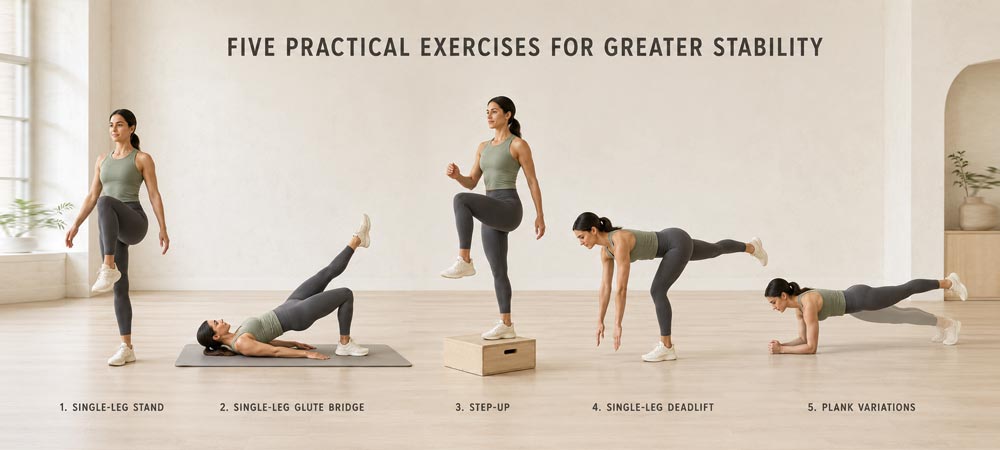
FIVE PRACTICAL EXERCISES FOR GREATER STABILITY
A short stability sequence performed two or three times per week can complement an existing fitness programme. The following exercises require little equipment and can be adjusted to suit different levels of ability.
1. SINGLE LEG STAND
Stand on one leg for 30 to 45 seconds while maintaining an upright posture. Keep the pelvis level and avoid gripping excessively with the toes.
Once this becomes easy, gradually increase the challenge by turning the head slowly, moving the arms or standing on a slightly softer surface. Always remain close to a wall or secure support if balance is uncertain.
2. SINGLE LEG GLUTE BRIDGE
Lie on your back with one knee bent and the foot placed on the floor. Lift the opposite foot, then raise the hips while pressing through the supporting leg.
The aim is to keep the pelvis level rather than allowing it to rotate or drop. Move slowly and focus on control.
3. STEP UP
Step onto a stable platform, keeping the hip, knee and foot aligned. Avoid pushing excessively from the leg that remains on the floor or allowing the knee to collapse inward.
Pause briefly at the top before lowering yourself with control. The descent is just as important as the ascent.
4. SINGLE LEG DEADLIFT
Stand on one leg with the knee slightly bent. Hinge forward from the hip while allowing the other leg to extend behind you.
The spine should remain long and the pelvis as level as possible. Depth is secondary. Balance and alignment are the priorities.
5. PLANK VARIATIONS
Begin with a standard plank and establish good technique before progressing. Maintain a neutral spine, steady breathing and an active connection through the shoulders and trunk.
Once this position can be held without compensation, the challenge may be increased by lifting one foot, reducing the number of support points or carefully changing the support surface.
Two or three sets of each exercise are generally sufficient, provided the duration or number of repetitions allows good form to be maintained.
CONTROL BEFORE COMPLEXITY
One of the most common mistakes in stability training is introducing more instability than the body is ready to manage.
An unstable condition may reveal an existing weakness or movement dysfunction, but it does not necessarily correct it. If a person cannot maintain alignment during a basic movement, increasing the difficulty may simply reinforce the compensation.
Making a poor movement more challenging does not transform it into a better movement.
A sensible progression is:
Movement quality first. Control second. Resistance next. Instability when appropriate.
This approach may appear less dramatic than performing complex exercises on unstable equipment, but it is more purposeful. The objective is to teach the body to respond with greater control and adaptability.
FITNESS IS ALSO ABOUT CONTROL
Fitness is not defined solely by muscular appearance or the amount of weight a person can lift. Physical capacity emerges from the interaction of strength, mobility, balance, coordination and stability.
When used thoughtfully, stability training can support athletic performance, rehabilitation, everyday movement and healthy ageing. It can make the body more responsive in controlled exercise environments and during the unexpected moments of daily life.
There is no need to perform every exercise on a BOSU ball or turn an entire workout into a balancing act. Often, the most effective progression is far simpler: stand on one leg instead of two, carry a load on one side rather than both, or perform a basic plank with greater precision.
Strength is more than the ability to generate force.
True strength is the ability to control that force at the right moment, in the right direction and with the intelligence to adapt.