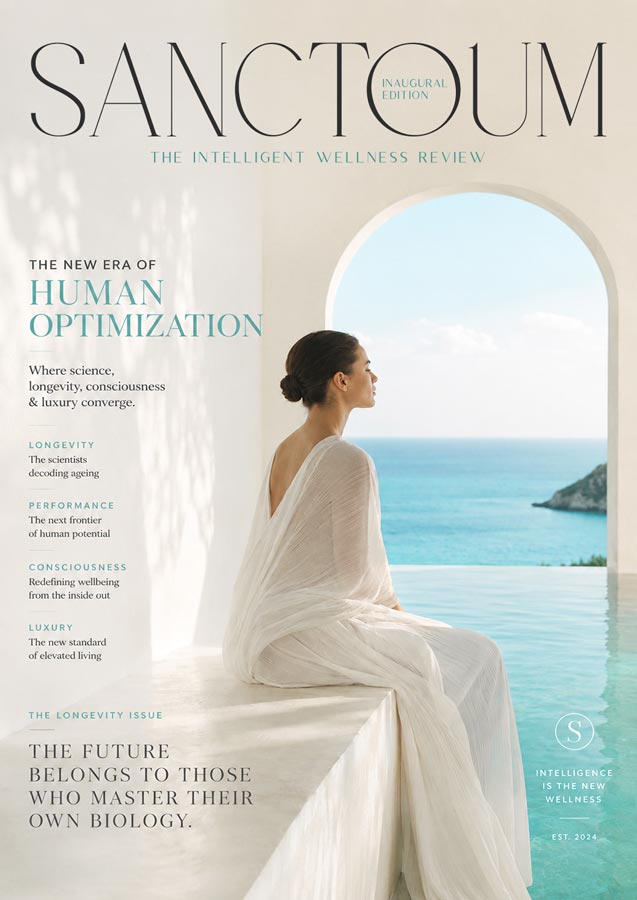

The Founding Feature of SANCTOUM
A conversation between Karine Lackner and Sai Ganesh Nagpal on destiny, free will and the lifelong journey of becoming yourself.
here comes a moment in almost every life when success quietly loses its ability to answer our deepest questions. It rarely arrives during failure. More often, it appears after achievement. The career has been built, the family has grown, the goals have been reached. From the outside, life may look exactly as it was imagined.
Yet somewhere beneath the surface, another conversation begins. It cannot be measured in promotions, possessions or applause. Its questions are deeply personal and profoundly universal.
Am I becoming the person I was meant to become?
Am I living according to my own truth, or simply fulfilling expectations that were never truly mine?
How do I know I am on the right path?
Every generation has searched for answers to these questions. Some have turned to philosophy or religion, others to psychology or ancient traditions that have survived through changing civilisations. The methods differ, but the underlying longing remains remarkably similar. We are trying to understand ourselves.
It was this search that brought me to Sai Ganesh Nagpal.
Like many people, I approached our meeting with curiosity. Astrology occupies an unusual place in modern society. It is embraced passionately by some, dismissed entirely by others and frequently misunderstood from both directions. Vedic Astrology, one of the oldest knowledge systems still practised today, has endured for thousands of years. Whatever one’s personal view, a tradition with such longevity deserves to be understood before it is judged.
I was not looking for predictions or certainty. I wanted to understand why thoughtful, intelligent people continue to dedicate their lives to studying an ancient system in an age shaped by neuroscience, genetics and artificial intelligence.
“People spend so much time trying to discover their purpose that they forget to become the person capable of fulfilling it.”
As our conversation unfolded, astrology gradually became secondary. What we were really discussing was human nature.
One of the first things Sai said stayed with me long after our conversation ended.
“People come wanting to know what will happen.”
He smiled.
“Very few come wanting to understand themselves.”
The observation was simple, yet it exposed something familiar. Modern life teaches us to become skilled planners. We plan careers, investments, holidays and retirement. Even happiness is often scheduled somewhere in the future.
Far less attention is given to understanding the person making all those plans.
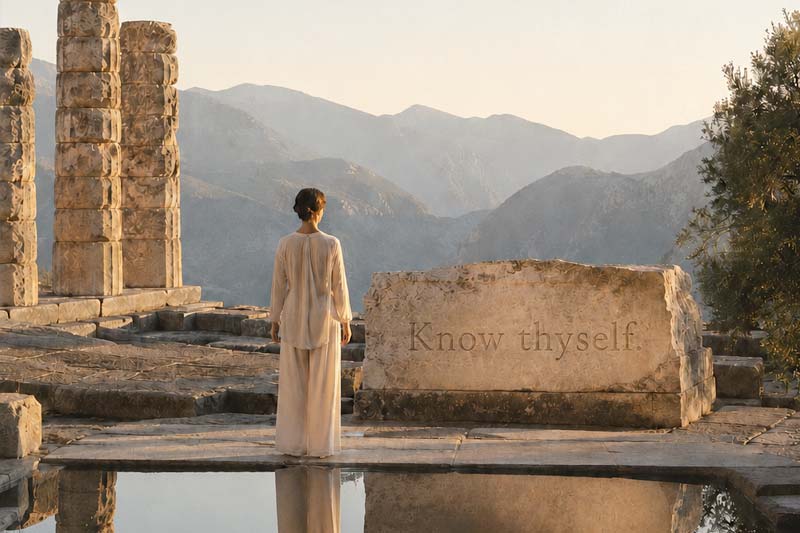
An inscription at the Temple of Apollo at Delphi has survived for more than two thousand years:
Know thyself.
Empires have risen and disappeared since those words were first engraved. Scientific revolutions have transformed our understanding of the universe, and technology has reshaped almost every aspect of human life. The invitation itself remains unchanged.
Know yourself, because self-knowledge matters.
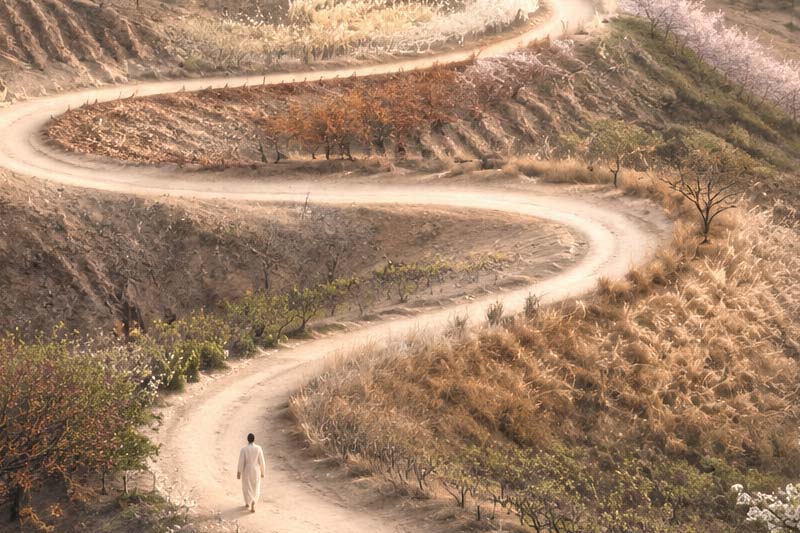
Throughout our conversation, Sai repeatedly returned to one principle: a birth chart is a map, not a verdict.
The distinction matters. Maps reveal landscapes, crossroads and possible directions. They may indicate rivers, mountains and obstacles, but no map forces a traveller to take a particular road. The choice still belongs to the person holding it.
This perspective challenged one of the most common assumptions surrounding destiny. In Sai’s view, destiny does not remove responsibility. Greater self-understanding can actually increase it, because awareness makes unconscious patterns harder to ignore.
Here, ancient wisdom begins to touch territory familiar to modern psychology. Both are concerned with patterns, awareness and the possibility of participating more consciously in our own lives.
In my work as a hypnotherapist, I have often seen how strongly early experience can influence adult behaviour. A child who is repeatedly criticised may become an adult who believes perfection is the price of acceptance. Someone raised in an unpredictable environment may spend decades trying to control everything around them. A person who learned that love had to be earned may struggle to believe they deserve it without performing for it.
These beliefs can become so familiar that we mistake them for personality.
Personality, however, is not always the same as identity. Some traits may simply have developed as adaptations to what came before. Awareness interrupts that automaticity. It creates space for questions that may previously have gone unasked.
Is this fear truly mine?
Is this belief actually true?
Who might I become if I no longer needed to protect myself from a past that no longer exists?
Different disciplines approach such questions through different frameworks. Psychology explores behaviour. Neuroscience studies the brain. Ancient philosophy investigates character. Vedic Astrology observes recurring patterns through its own traditional system.
Different languages, yet a familiar human search.
One quality I appreciated in Sai was his absence of certainty. That may sound unusual in a culture that often equates expertise with having answers. Yet many of the wisest people I have encountered are distinguished by the quality of their questions.
Sai made no attempt to persuade me. He did not suggest that astrology should replace reason, nor did he dismiss science in favour of spirituality. He spoke with the ease of someone who had spent decades observing people and their lives without needing to prove his position.
Our conversation gradually moved beyond charts, planets and calculations. We began speaking about choice, identity, responsibility and timing, subjects that belong to far more than astrology.


TIMING, CYCLES AND THE PRESSURE TO ARRIVE
Timing fascinated me.
Modern culture rewards urgency. Results are expected quickly. Healing should be measurable within weeks, success should arrive early and growth should remain visible. We are constantly encouraged to move faster.
Nature operates differently. Trees take decades to mature. Seeds develop beneath the soil before anything becomes visible. Every season has its own function. Winter is not failing because it does not resemble spring.
Yet when our own lives become quiet or appear to stall, we often interpret stillness as regression. Perhaps we are simply living through a season whose meaning is not yet visible.
Sai described life as unfolding through cycles rather than straight lines. The idea felt immediately familiar.
Looking back over my own life, from Austria to Monaco, from interior design to wellness, from outward achievement towards inner transformation, I could see how many experiences that once appeared to be endings later revealed themselves as beginnings.
At the time, I could not have known. Very few of us can. Meaning often arrives after experience.
I asked Sai whether people misunderstand destiny.
“They think destiny means everything is fixed.”
“I don’t believe that.”
His answer was clear. Life may contain tendencies, possibilities and recurring lessons. Within those conditions, choice remains.
This is where responsibility enters the conversation. The past may help explain us, but transformation asks more of us. We cannot rewrite our beginnings, yet we retain considerable freedom in how we continue the story.
Another observation Sai made stayed with me.
“People spend so much time trying to discover their purpose that they forget to become the person capable of fulfilling it.”
I wrote the sentence down immediately because it felt true.
Purpose is often imagined as a destination waiting somewhere in the future. Perhaps it develops more like a relationship, becoming clearer as we mature and as our capacity to recognise it deepens.
The older I become, the less convinced I am that fulfilment comes from discovering one perfect answer. It seems more closely connected to the quality of the questions we are willing to ask, particularly those that require honesty, patience and a willingness to reconsider ourselves.
THE INTELLIGENCE OF PRESENCE
Modern society has become exceptionally efficient at telling us how to improve. Books promise success. Podcasts teach productivity. Courses offer optimisation. Advice is everywhere, usually focused on becoming more accomplished, resilient or influential.
Far less attention is given to presence.
Presence is an understated form of intelligence. It does not solve every problem, but it allows us to meet experience more fully. Attention shapes what we notice, how we interpret events and, over time, the life we believe ourselves to be living.
Two people can move through similar circumstances and carry away very different stories. One may see primarily obstacles, another may notice possibilities within the same experience. Neither perspective is entirely objective. Both are influenced by attention.
Attention can be cultivated.
By the end of our conversation, I had arrived expecting to learn about astrology and found myself thinking instead about awareness, identity and the courage required to know ourselves honestly.
Perhaps ancient wisdom traditions continue to endure because they ask questions that do not become obsolete.
Who am I?
What matters most?
How should I live?
Technology evolves rapidly. Human nature changes far more slowly. Every generation encounters these questions, and every life must answer them anew.
UNCERTAINTY AND THE DESIRE TO KNOW
There is a persistent human temptation to believe that freedom begins when uncertainty ends.
If only we knew whether the business would succeed, whether the relationship would last, whether a diagnosis would improve or whether the decision ahead was the right one, perhaps then we could relax.
Life offers no such guarantee.
An entrepreneur cannot know whether a new company will survive. An artist facing a blank canvas cannot predict whether inspiration will come. Parents cannot know who their children will become.
Certainty is rarely available in advance. Awareness may be more useful.
This distinction remained present throughout my conversation with Sai. He did not present ancient wisdom as a way to avoid personal responsibility. His perspective moved in the opposite direction. Greater consciousness creates greater responsibility because it becomes more difficult to hide behind what we have never examined.
Once we truly see a pattern, pretending we have not seen it becomes harder.
One of the most interesting aspects of Vedic Astrology is its attention to patterns and cycles. Nature is full of them: seasons, tides, lunar rhythms, sleep cycles and the beating of the human heart.
Human lives rarely progress in perfectly straight lines either. We like to imagine growth as a staircase, each step leading steadily upwards. Experience often looks more like a spiral. Familiar lessons return. Old fears appear in new circumstances. Similar choices present themselves through different people or situations.
The recurrence can feel frustrating.
Why am I dealing with this again?
A more useful question may be:
What have I not yet understood here?
That shift can turn repetition into information.
THE PRACTICE OF OBSERVATION
During our conversation, I found myself thinking increasingly about observation.
It may be one of the capacities modern life most easily erodes. We scroll before we reflect, react before we observe and judge before we understand. Access to information has increased enormously, while familiarity with our own inner lives has not necessarily kept pace.
Observation asks us to slow down enough to notice and to remain curious before becoming certain.
Meaningful transformation often begins there. A physician needs information before making a diagnosis. A therapist listens before understanding. An architect studies the land before designing for it.
The same principle applies to our lives. Conscious change requires an honest view of what is already happening.
This may be one reason self-awareness deserves to be considered a form of intelligence. It reaches beyond intellect into something more fundamentally human.
Sai returned several times to the idea that life offers possibilities rather than guarantees. I found this reassuring.
Possibility is often experienced as uncertainty, although it can also be understood as freedom. A novel in which every chapter had been revealed before the first page would contain little suspense or discovery. Meaning emerges partly because we do not know exactly how the story will unfold.
Life asks something similar of us. Complete knowledge is unavailable. Presence is still possible.
MOVEMENT IS NOT ALWAYS PROGRESS
There is another tendency I have noticed in my own life and in the lives of people I have worked with over the years. We often confuse movement with progress.
We become busy. Calendars fill, meetings multiply and goals accumulate. Activity becomes constant.
Direction is something else.
A compass does not reward speed. It provides orientation. It is possible to move quickly in the wrong direction and slowly towards something deeply aligned.
Sometimes the more courageous act is to stop accelerating long enough to ask whether the road we are travelling is still our own.
This is one of the gifts of conversations such as the one I shared with Sai. They interrupt momentum long enough for reflection to return.
At one point, I asked whether people are too afraid of making the wrong decision.
He smiled.
“I think people are more afraid of trusting themselves.”
The answer surprised me. The longer I considered it, the more familiar it became.
How often do we seek one more opinion because we no longer trust our own judgement? How often do we hand responsibility to experts, mentors, institutions or traditions because uncertainty is difficult to tolerate?
Guidance can be invaluable. Dependence is something different.
Every genuine teacher eventually returns the student to themselves. Meaningful philosophies invite personal responsibility. A life remains individual, however much guidance surrounds it.
No chart, therapist, philosopher, editor or publication can live it for us. At their best, they can illuminate something we have not yet seen.
The walking remains ours.
THE PATH INWARD
Perhaps this is why so many profound traditions eventually turn inward.
The Stoics wrote about character. Buddhist teachings explore awareness. Modern psychology examines subconscious beliefs. Neuroscience studies perception and behaviour.
Their frameworks differ, while many of the questions converge.
How do we become less reactive? How do we live with greater awareness? How do we recognise patterns that no longer serve us?
Wisdom may have as much to do with refining perception as accumulating answers.
There is a phrase often attributed to Carl Jung that has stayed with me for many years:
“Until you make the unconscious conscious, it will direct your life and you will call it fate.”
Whether approached through psychology or ancient systems of self-understanding, the invitation is similar: become conscious.
Consciousness does not eliminate suffering. It can change our relationship with it.
In transformational therapy, I have often seen people arrive believing they need to become someone entirely new. Sometimes what they need is permission to stop maintaining versions of themselves built around fear, protection or expectations that no longer belong to them.
Healing can involve remembering what existed before life taught us to move away from it.
Information, Wisdom and What Deserves Our Attention
When I left my conversation with Sai, I found myself thinking about the difference between information and wisdom.
Information tells us what. Wisdom asks why. Information accumulates, while wisdom can simplify.
Never before have we had access to so much knowledge, yet anxiety, burnout and emotional exhaustion remain widespread. Perhaps the challenge is increasingly one of discernment: deciding which knowledge deserves our attention.
That question takes us beyond novelty and towards what endures.
I have always believed that a meaningful publication should offer more than information. It should create perspective. A well-written article need not tell readers what to think. It can invite them to think more deeply.
If these pages leave you asking yourself a question you had never considered before, then this conversation has already served its purpose.
Transformation rarely begins with certainty. Very often, it begins with a better question.