
Too Comfortable For Our Own Good
FROM AUSTRIAN WINTERS TO ARABIAN SUMMERS: WHAT TEMPERATURE, MODERN COMFORT, AND A LITTLE HEALTHY DISCOMFORT CAN TEACH US ABOUT LONGEVITY.
here is a certain irony in being born in Austria, a country where winters can be long, cold, and spectacularly beautiful, only to discover that your preferred climate is the warmth of the Arabian Peninsula.
I have always preferred warmth to cold. Perhaps that explains why I feel so comfortable living in the UAE, where sunshine is abundant and winter means enjoying lunch outdoors rather than scraping ice of a windscreen.
Yet there is one small contradiction.
In a country blessed with so much warmth, we seem determined to refrigerate ourselves.
Walk into certain shopping malls, restaurants, hotels, or offices in Dubai or Abu Dhabi, and you might wonder whether you have accidentally boarded a flight to the Arctic. Outside, the thermometer reads 38°C. Inside, you are searching for a cardigan.
We have developed extraordinary technology to protect ourselves from extreme temperatures. But somewhere along the way, have we confused comfort with health?
And could our obsession with maintaining the perfect indoor temperature be depriving our bodies of something they actually need?

THE HUMAN BODY WAS NOT DESIGNED FOR A CONSTANT 22°C
For most of human history, temperature was not something we controlled with a remote.
Our ancestors experienced changing seasons, chilly mornings, hot afternoons, and significant fluctuations between day and night. Their bodies responded continuously, adjusting circulation, perspiration, metabolism, and energy expenditure to maintain internal imbalance.
Human beings evolved with a sophisticated biological temperature-regulation system known as thermoregulation. At the center of this system is the hypothalamus, a small region of the brain that acts as our internal thermostat.
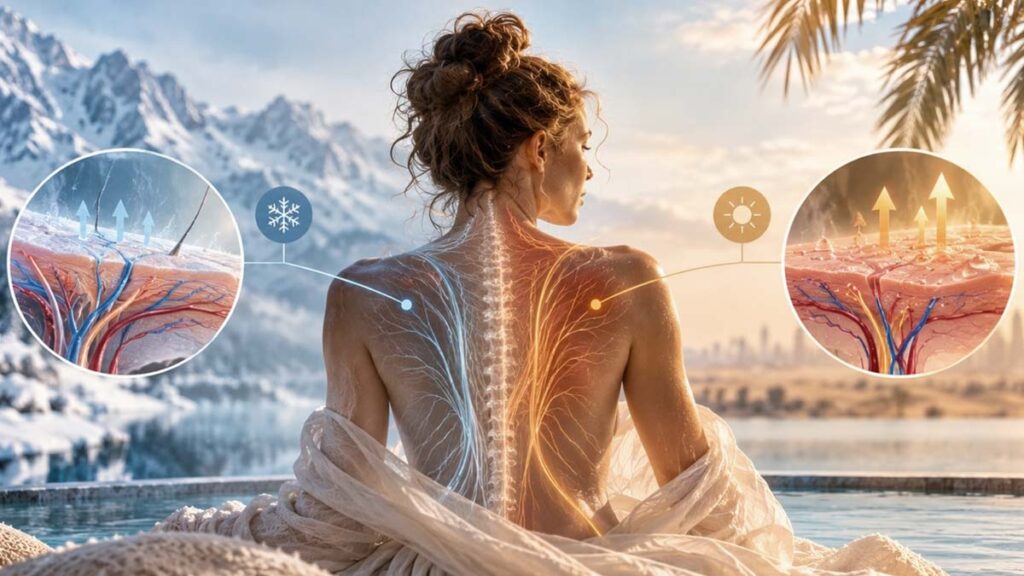
When we become too warm, blood vessels near the skin expand, and sweat helps dissipate heat through evaporation. When temperatures fall, blood vessels constrict to conserve warmth, muscles may begin shivering, and the body activates other mechanisms to generate heat.
These are not inconveniences or biological imperfections. They are extraordinary examples of human adaptability. Yet today, particularly in highly urbanized societies, we can spend almost every waking hour in environments where the temperature barely changes.
We sleep in air-conditioned bedrooms, drive air-conditioned cars, work in air-conditioned offices and exercise in air-conditioned gyms.
In the UAE, we sometimes need a jacket indoors in the middle of August. Our ancestors might have found that rather difficult to explain.
WHEN COMFORT BECOMES A BIOLOGICAL HABIT
Modern convenience has undoubtedly improved human life. Climate control protects vulnerable populations from dangerous heat and cold, improves productivity, and makes living in challenging climates considerably more manageable.
In the UAE, air-conditioning is not simply a luxury. During the hottest months, it is essential infrastructure. The question is not whether we should abandon it. The question is whether we need quite so much of it.
Research into human metabolism suggests that spending most of our time within a narrow, comfortable range can reduce the need for certain adaptive responses.
For example, our bodies contain different types of fat tissue.
White fat primarily stores energy. Brown adipose tissue, commonly called brown fat, has a different function: it can burn energy to generate heat. Mild cold exposure can stimulate brown fat activity, a process known as non-shivering thermogenesis.
Scientists are investigating whether regular, controlled exposure to cooler temperatures may influence metabolic flexibility, glucose regulation, and energy expenditure.
The findings are intriguing, although it is important not to confuse biological responses with proven long-term health outcomes. Activating brown fat does not automatically translate into meaningful weight loss or a longer life.
Still, the underlying message is fascinating. Our environment does more than surround us. It continuously communicates with our biology.
THE PARADOX OF AIR-CONDITIONED LIVING
There is another interesting dimension to the UAE’s relationship with temperature.
We live in one of the world’s warmest regions, yet many indoor environments are maintains at temperatures that feel surprisingly cold. The contrast can be dramatic.
Imagine stepping out of a building cooled to 19°C into an afternoon approaching 40°C. Your body must rapidly adjust its circulation and heat-loss mechanisms to accommodate the change.
A healthy thermoregulatory system is generally capable of handling such transitions, but abrupt changes can feel uncomfortable, particularly for people sensitive to cold. Air-conditioning also influences indoor humidity. Cooling systems remove moisture from the air, and excessively dry indoor environments may contribute to dry eyes, irritated nasal passages, dry skin, and throat discomfort.
As someone who genuinely enjoys warmth, I sometimes find myself wondering why we need to create an Austrian winter inside an Arabian building. Surely there must be a middle ground.
However, it would be misleading to suggest that air-conditioning itself is inherently unhealthy. Well-maintained systems improve thermal safety and can help filter airborne particles. Problems arise when temperatures are unnecessarily low, humidity is poorly managed, ventilation is inadequate, or equipment is neglected.
The goal should be a healthy indoor environment, not simply the coldest possible one.
A LITTLE STRESS CAN BE A GOOD THING
Here is where the science becomes particularly interesting.
We usually associate stress with something negative. Chronic psychological stress, poor sleep, inflammation and prolonged psychological strain can certainly harm our health. But not every form of stress is detrimental. The body has evolved to respond to manageable challenges, and some of those responses can strengthen its capacity to adapt.
This concept is known as hormesis.
Hormesis describes a biological phenomenon in which a low or moderate dose of a stressor triggers beneficial adaptive responses, even though a larger dose of the same stressor may be harmful.
Exercise offers a familiar example. When we lift weights, we temporarily challenge muscle tissue. With adequate nutrition and recovery, the body responds by becoming stronger. Heat exposure may engage some comparable adaptive pathways.
During sauna bathing, rising body temperature increases heart rate, changes circulation, and stimulates cellular stress responses, including the production of heat shock proteins. These proteins help maintain and repair other proteins under stressful conditions.
Researchers are studying how these processes might contribute to cardiovascular and metabolic health.
Observational studies have associated frequent sauna use with favorable cardiovascular outcomes, although they cannot establish that sauna bathing itself causes longer life.
Cold exposure activates different mechanisms, including sympathetic nervous system activity and heat production. But an important distinction is necessary: a psychological response is not automatically a healthy benefit. An ice bath may feel invigorating, but the evidence for broad longevity benefits remains limited. Extreme cold can also be dangerous, particularly for people with cardiovascular conditions.
The secret is not to make ourselves suffer. It is to introduce appropriate challenges without overwhelming our biology.

HEAT, COLD, AND THE ART OF ADAPTATION
Could the future of wellness involve becoming less dependent on perfect comfort? Interestingly, some of the world’s oldest wellness traditions have long incorporated temperature as part of daily life.
The Finnish Sauna
A centuries-old tradition of dry heat, relaxation, and communal bathing. Modern research is exploring its potential cardiovascular benefits.
Japanese Onsen
Hot-spring bathing combines warmth, ritual, stillness, and a connection with nature, with relaxation playing a central role.
The Moroccan Hammam
A tradition of warm, humid bathing, cleansing, and social connection, demonstrating that thermal wellness is also a cultural experience.
These practices remind us that temperature has never been merely a question of convenience. It has also been associated with restoration, ritual, and human connection. Today, luxury wellness retreats offer elaborate thermal circuits, alternating warm pools, saunas, steam rooms, and cold plunges. We are effectively paying for experiences that deliberately challenge the temperature regulation our climate-control systems work so hard to avoid.
There is something rather amusing about that.
PERHAPS WE SHOULD LISTEN TO OUR BODIES AGAIN
The answer is not to switch off the air-conditioning during a UAE summer or to force ourselves into freezing water every morning. Extreme temperatures carry genuine risks, and heat tolerance varies considerably with age, health, medication, hydration, and acclimatization. Instead, we can become more conscious of our thermal environment.
Perhaps we could set the air-conditioning a little higher when conditions allow, spend more time outdoors during the beautiful UAE winter, and enjoy a warm sauna if medically appropriate, or simply stop assuming that every room needs to feel like a refrigerator.
Even modest variations in ambient temperature can give the body’s regulatory systems an opportunity to respond, although we still need more research to establish how much this translates into long-term health benefits.
There is also an environmental dimension.
In hot climates, cooling buildings consumes substantial energy. Reducing unnecessary cooling, improving building design, using effective shading, and optimizing ventilation can support both human comfort and environmental sustainability.
Wellness, after all, should not end at the boundaries of our skin. The health of our bodies and the health of our surroundings are deeply interconnected.
THE LUXURY OF FEELING NATURAL AGAIN
The greatest luxury of modern life is not the ability to control every aspect of our environment. It is having the freedom to choose when to embrace comfort and when to welcome a little challenge.
Our biology developed in a world of movement, changing temperatures, natural light, darkness, and seasonal rhythms. Technology has given us remarkable protection from environmental extremes. But it has also made it possible to live increasingly disconnected from the natural conditions that shaped us.
We do not need to recreate the hardships of our ancestors to appreciate the intelligence of our physiology. We simply need to remember that adaptability is part of being human.
As for me, I will happily continue exchanging Austrian winters for Arabian sunshine. I have absolutely no desire to prove my resilience by standing barefoot in the snow.
But I would be delighted if my next restaurant in Dubai served dinner at a temperature that did not require a cashmere shawl.
After all, wellness should make us feel more alive, not permanently refrigerated.
SANCTOUM Editorial Note:
Thermal therapies are not suitable for everyone. People with cardiovascular conditions, blood-pressure instability, pregnancy-related concerns, or other relevant medical conditions should seek individualized medical guidance before attempting intense heat or cold exposure.