This conclusion led to the development of a new approach referred to as “Endogenous Stem Cell Mobilization” (ESCM), the release of one’s own stem cells. In other words, instead of increasing the number of circulating stem cells through an injection, we can do so simply by supporting the natural release of stem cells from the bone marrow.
Aside from being safe and effective, such an approach can be accessible to anyone, anywhere in the world. ESCM is a game changer in the world of health and wellness. But to understand the potential of this approach we first need to understand what stem cells are and what they do in the body, and then what we can do to support our body’s own stem cells.
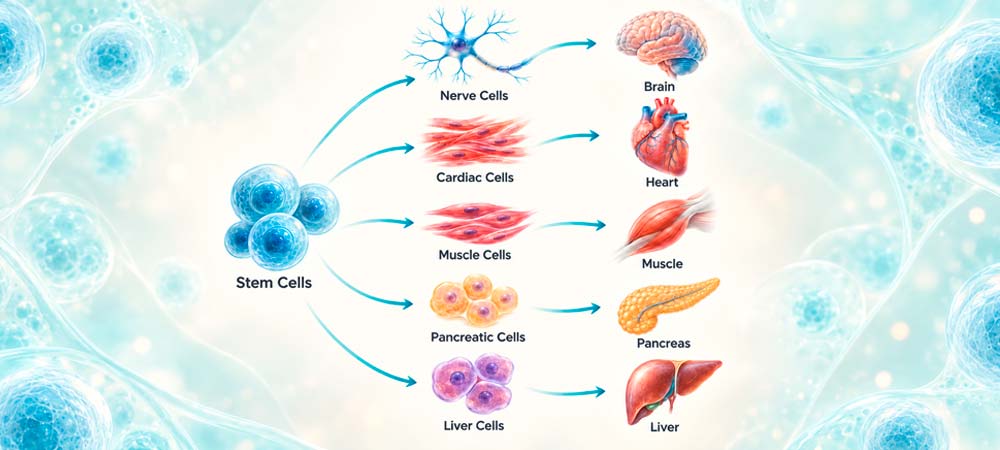
Stem cells are defined as cells with the unique ability to self-replicate throughout the entire life of an individual and to differentiate (transform) into cells of various tissues. Most cells of the body are specialized and play a well-defined role in the body. For example, brain cells respond to electro-chemical signals from other brain cells and release neurotransmitters, cells of the retina are activated by light, and pancreatic ß-cells produce insulin.
These cells, called somatic cells, will never proliferate and differentiate into other types of cells. By contrast, stem cells are primitive cells that remain undifferentiated until they receive a signal prompting them to transform into specific types of specialized cells. Generally speaking, there are two types of stem cells: embryonic stem cells and adult stem cells.
Embryonic stem cells are cells extracted from the blastula, the very early embryo, while adult stem cells are stem cells found in the body after birth. The term “adult stem cells” does not refer to a characteristic associated with adulthood, it is simply a descriptor that contrasts with the developing embryo.
Stem cells in the bone marrow of a newborn, for example, or even stem cells found in the umbilical cord are referred to as adult stem cells. The approach of ESCM obviously pertains to stem cells found in the bone marrow after birth. An example of stem cells’ ability to convert into tissue cells is provided by the study of Jang et al. who performed an elegant experiment in which stem cells were co-cultured with either normal or damaged liver tissue.
The stem cells and liver tissue were separated by a semipermeable membrane with pores large enough to let molecules pass through, but small enough to prevent the passage of cells from one compartment to the other. Using markers for both stem cells and livers cells, the scientists documented that when stem cells were placed in the presence of damaged liver tissue, they rapidly began to transform into liver cells.
There are two types of bone marrow: red and yellow or fatty marrow. Stem cells are produced only in the red marrow. In children, the bones contain only red marrow. However, as the skeleton matures, fat-storing yellow marrow displaces red marrow in the shaft of long bones. Already by age 28, most of the red marrow has been displaced by fatty marrow and red marrow remains mainly in the ribs, the vertebrae, the pelvic bones, and the skull.
Since stem cells are only produced in the red marrow, the transformation of red marrow into yellow marrow explains the decline in stem cell production with age.
And herein lies one of the most fundamental causes of aging: as we age the number of circulating stem cells decreases, reducing the body’s ability to repair and renew.
Excerpted from the e-book The_Human_Repair_System-ebook-2025-v3 by Christian Drapeau.
About the author:
Christian Drapeau is a scientist, author, medicinal plant expert, and pioneer in the field of stem cell research. He holds a graduate degree in Neurophysiology and has been involved in medical research for 30+ years, with the last 20 specifically dedicated to stem cells. He pioneered the understanding that stem cells constitute the body’s natural healing and repair system, and has traveled the world in search of the most powerful plants that support stem cell function and enhance the body’s regenerative potential. Having lectured in 50+ countries and written 5 books – including the best-selling Cracking the Stem Cell Code – as well as dozens of published scientific papers on brain research and Endogenous Stem Cell Mobilization, Drapeau is known by scientists, physicians, and biohackers alike as an expert and pioneer of his field. A scientific advisor to many companies, he is currently the Founder and Chief Science Officer at STEMREGEN, where he developed the most potent stem cell supplement.
Christian’s Instagram
Christian’s TikTok
Stemregen Facebook
Christian’s Linktree
Websites:
www.stemregen.co