The Longevity Kitchen – Japan
WHAT JAPANESE FOOD CULTURE REVEALS ABOUT SEASONALITY, MEMORY, CONNECTION, AND THE QUIETER ART OF LIVING WELL.
efore longevity had a name. Perhaps the oldest longevity practice was never found in a laboratory. Perhaps it was found around the table.
Today, longevity has become an industry of measurement. We monitor sleep, analyze biomarkers, optimize nutrition and search for interventions that might extend our healthy years. Yet long before longevity had a name, cultures had developed their own ways of understanding nutrition, seasonality, balance and care.
Japan is frequently held up as an example. From the outside, its relationship with longevity is often reduced to a collection of familiar ingredients and ideas: green tea, fermented foods, fish, seaweed and hara hachi bu.
But a food culture cannot be understood through ingredients alone.
It lives in the season in which something is eaten. In the hands that prepare it. In the vessel chosen to hold it. In the instinct not to waste what can still nourish. And the people gathered around the table.
For this edition of The Longevity Kitchen, SANCTOUM looks beyond the idea of a Japanese longevity diet to explore something more revealing: the everyday culture surrounding food.
Our guide is Sachiko Tachi, a photojournalist and product buyer who has lived in different parts of Japan, including Kyoto, and has made Okinawa her home since 2013. Her work has brought her into close contact with farmers, food producers, craftspeople and the landscapes from which their work emerges.
Rather than offering a prescription for living well, Sachiko shares a personal perspective on what it means to live well.
And her story begins, appropriately, at home.
01 – SEASONS AT THE TABLE
Q: When you think about Japanese food culture, what does food mean to you beyond nutrition?
A: Looking back, I believe the richness of Japanese food culture lies not only in fine cuisine or rare ingredients, but in the way we experience the changing seasons through the food on our tables.
My father was born in Hokkaido and my mother was born and raised in Tokyo. When I was growing up, some days we ate Japanese food and other days Western-style dishes. My mother even attended bread-making classes and would sometimes prepare meals around the bread she had baked.
Whatever the cuisine, the seasons were always naturally present.
Spring brought bamboo shoots, nanohana blossoms and wild mountain vegetables. In summer, we ate cucumbers, tomatoes, eggplants, edamame and some noodles. Autumn meant mushrooms, chestnuts, sweet potatoes and Pacific saury. In winter, there were more hot pots and stewed dishes.
We never said consciously. “The season has changed, so let’s eat this.”
It was simply woven into everyday life.
One of my strongest childhood food memories is my mother’s hayashi rice, a Japanese Western-influenced dish of beef and onions simmered in a rich sauce and served over rice.
She made hers using the liquid released by vegetables, tomato juice and plenty of red wine. The following day, she would reduce the leftover sauce, hollow out a round loaf of bread, and fill with the hayashi rice, top it with cheese and bake it.
Although we were eating the same dish two days in a row, it felt like something entirely new. Looking back, I imagine this was her way of making leftovers delicious and exciting again.
For me, eating has never simply been about nourishing the body. It means sitting around the same table with family, having someone cook for you and sharing food with people you love.
It’s about saying to one another, “This is delicious.”
“To me, food is connection. And it is one of life’s great pleasures.”
02 – THE ART OF PAYING ATTENTION
Q: Japan is known for the care given to even the simplest meal. What does that attention reveal about the way food is valued?
A: Having grown up in Japan, treating food with care and presenting it beautifully were part of my surroundings long before I stopped to ask why. There is a sense that a dish is not complete through flavour alone. The vessel in which it is served is also part of the dish.
The same food can make a completely different impression depending on the play or bowl. We choose vessels according to the season and the food. We think about colour, balance, height and empty space.
“In Japan, we have an expression: to eat with the eyes.”
First we appreciate the beauty, then the aroma and finally the taste. The meal is experience through all sense. Avoiding waste is another familiar part of everyday life.
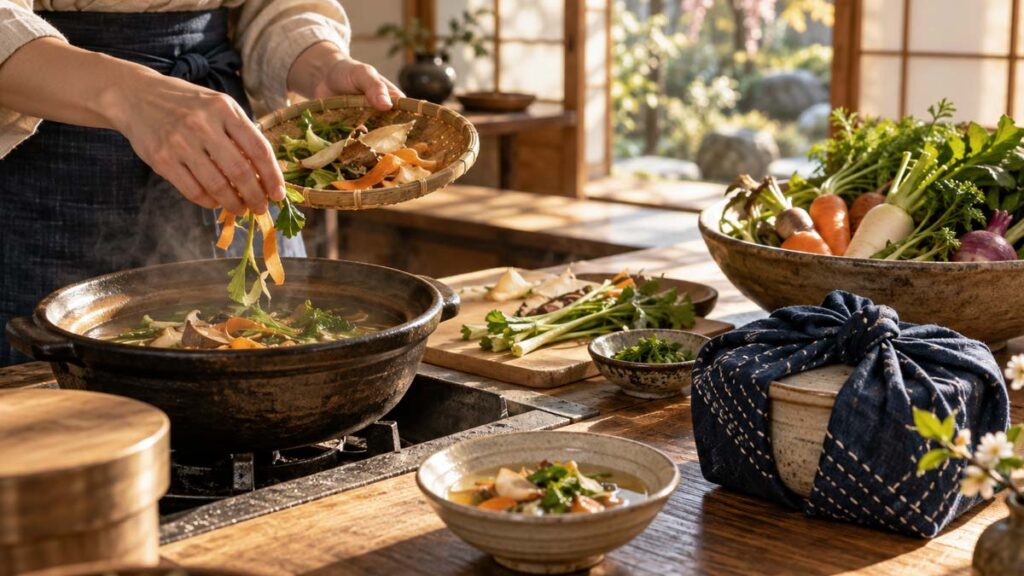
With a daikon radish, for example, we can eat the root but also chop and sauté the leaves or mix them into rice. If we buy a whole fish, the flesh may be eaten as sashimi or grilled, while the head and bones can be used to make ara-jiru, a soup.
Even kombu used to make stock can be sliced and simmered with soy sauce to become another dish. We have a word for this: mottainai.
It means more than simply thinking it is a shame to throw something away. It recognises the value that remains in something.
Before eating, we say itadakimasu. Afterwards, gochisosama.
These expressions convey gratitude for the food, the life and the labour behind it, and the person who prepared it. We do not consciously analyse these things at every meal. They become habits because they are repeated from childhood.
For me, respect for food was something absorbed naturally at the everyday table.
03 – OKINAWA: FOOD, PLACE AND BELONGING
Q: Having lived in Kyoto and Okinawa, what have you discovered about the relationship between food, place and community?
A: Kyoto and Okinawa are completely different places, and both have taught me how deeply food is connected t a region’s climate, history and identity.
Kyoto has distinctive vegetables such as Manganji peppers, Kujo spring onions and Kamo aubergines, as well as ingredients such as yuba and nama-fu. Living there makes the Japanese practice of eating the season especially tangible.
Okinawa has its own ingredients: goya, young loofah called nabera, moui, mozuku seaweed and Okinawan shallots.
But its food culture also reflect history. Tinned pork luncheon meat and canned tuna are commonly used, while steaks and hamburgers became part of everyday life through American influence.
That taught me something important: regional food culture is not made only from things that have always been there. It also reflects the people, histories and influences that have arrived over time.
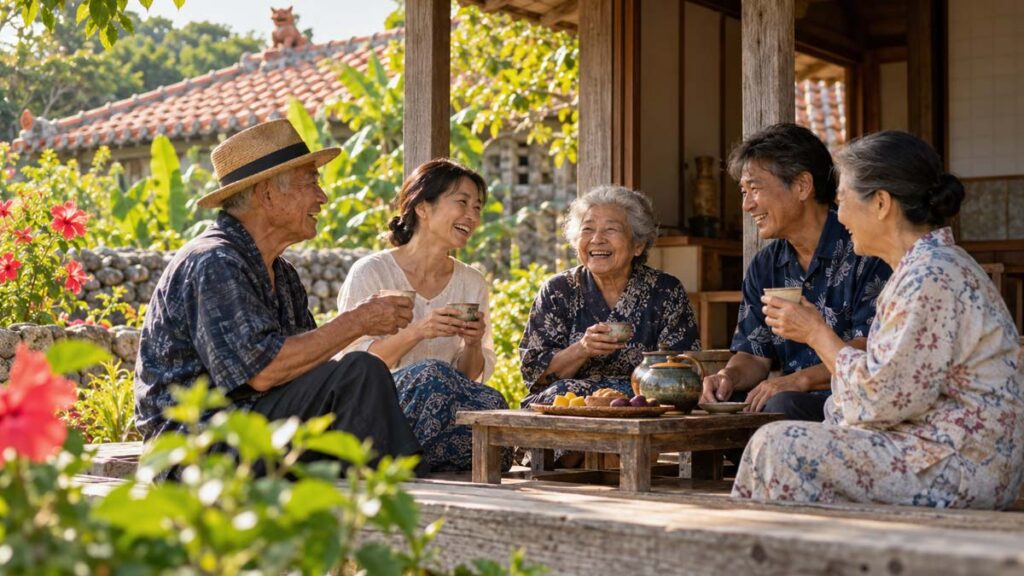
After moving to Okinawa in 2013, I was struck by how naturally food exists within everyday social life. People have their favourite Okinawa soba shops. Relatives gather around food for celebrations, annual observances and memorial services.
There is also the Okinawan custom of moai, a mutual-support group whose members meet regularly and contribute money to a shared fund. These gatherings are also opportunities to maintain friendships and relationships, often over food and drinks.
“Whenever people gather, food appears naturally”
Living in Okinawa has also changed my relationship with time.
In Tokyo, life often seems to prioritize speed and efficiency. I am still very busy in Okinawa, but I have learned to value conversations and time that does not demand an immediate result.
Through my work with farmers, food producers and craftspeople, I have also begun looking beyond the finished product. I think about who made it, where it came from and how it was produced.
Behind every ingredient or object, there is a place, a technique and a person.
04 – WHEN TRADITION BECOMES A TREND
Q: Japanese foods and traditions are increasingly celebrated by the global wellness industry. What do you think gets lost when they are separated from their cultural context?
A: I am very pleased that Japanese food culture and ways of thinking are attracting attention overseas. At the same time, when one element is removed from its context, the meaning behind it can become difficult to see.
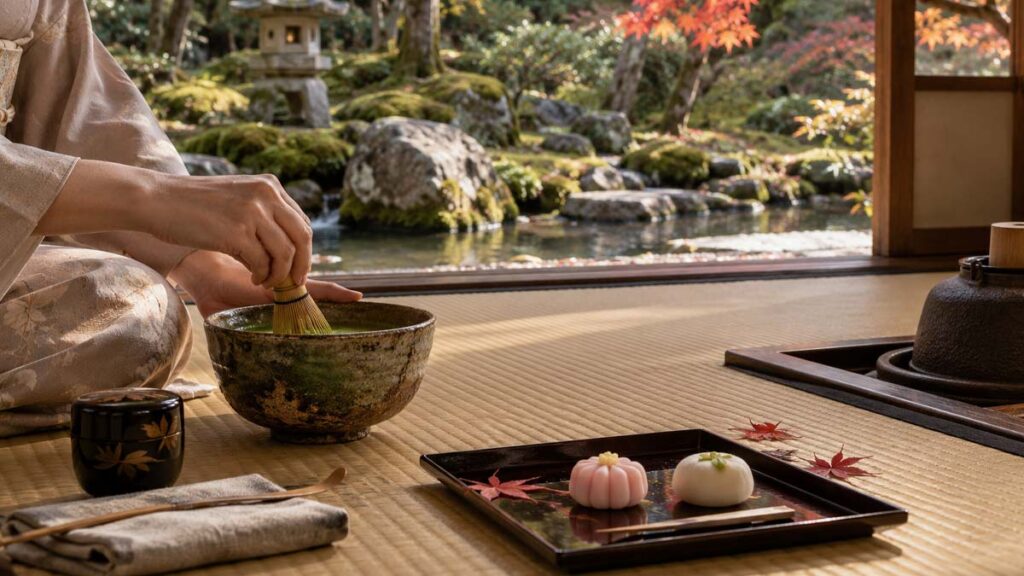
Matcha is one example.
Overseas, it is often introduced as a superfood and enjoyed in lattes, smoothies and sweets. I find this expansion fascinating, but in Japan matcha is much more than an ingredient.
The tea ceremony embodies a culture of hospitality in which tea is prepared to welcome another person. The bowl, seasonal sweets, flowers, hanging scroll, surrounding space and the time devoted to preparing tea for a guest are all part of the experience.
if matcha is seen only as an ingredient, everything behind it can disappear from view.
The same is true of fermented foods.
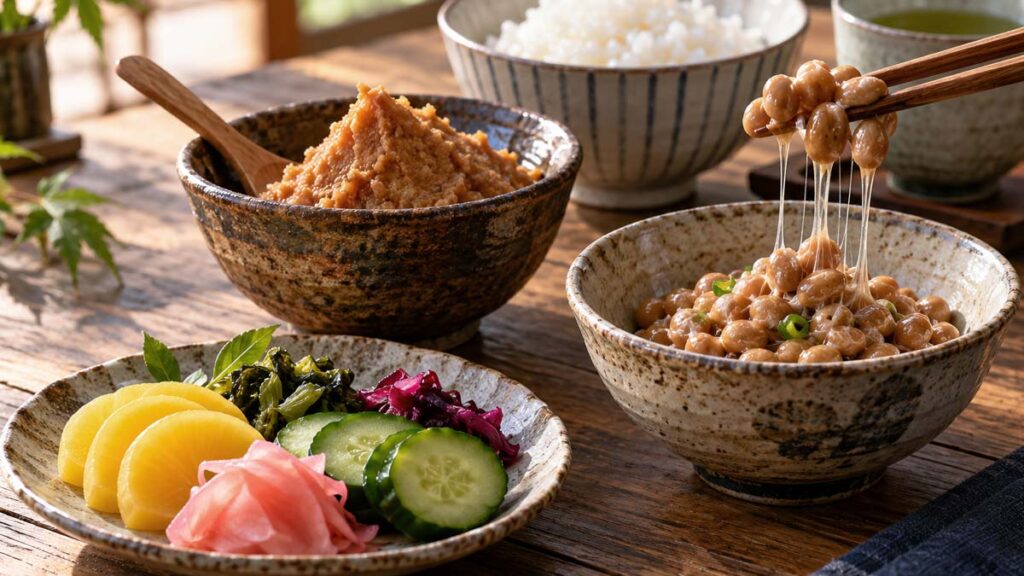
Miso, soy sauce, vinegar and pickles existed as everyday foods and methods of preservation long before they became associated with modern conversations about gut health. Their flavors and preparation methods differ from region to region, reflecting local climates, tastes and traditions.
There is also a tendency to imagine that Japanese people live long because they eat traditional washoku every day.
But contemporary Japan is much more varied. Pasta, curry, Chinese dishes, hamburgers and convenience store meals are all part of modern life.
Traditional customers remain, but the way people live is changing.
For that reason, I think Japanese longevity is better understood not through one ingredient or one custom, but through the accumulation of small daily habits: how people eat, move and rest.
I am delighted when people take an interest in Japanese food culture. I simply hope they will also discover the context in which those foods developed. That fuller picture makes the culture even more rewarding to explore.
05 – THE TABLE I WOULD INVITE YOU TO
Q: If someone were visiting Japan for the first time and you could invite them to just one table, where would you take them?
A: I would deliberately choose not to take them to an exclusive ryotei or famous restaurant. Instead, I would invite them to an ordinary Japanese family table.
When I travel abroad, I love the idea of visiting a market or supermarket with someone local, choosing ingredients that are in season, cooking together and sharing a meal.
I believe this reveals aspects of life that cannot always be understood through a restaurant. I would want someone visiting Japan to experience the same thing.
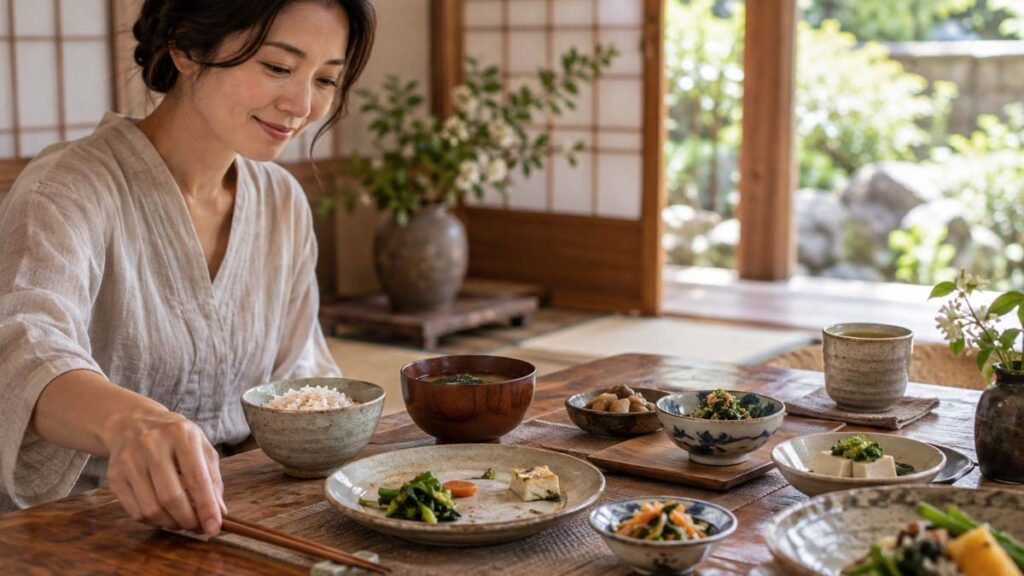
We would go to the market, choose fish and vegetables at their seasonal best and cook together. The food would not need to be elaborate. We might grill seasonal fish, prepare vegetables, and serve rice and miso soup. I would simply want to place on the table whatever was delicious in that place at that moment.
Once the food was ready, we would choose vessels to complement each dish and give a little care to the presentation. Then we would say itadakimasu and sit down together.
Cooking for someone.
Eating what is in season.
Choosing the vessels and arranging the food beautifully. And sharing it while saying, “This is delicious.”
When they leave, they may not need to feel that they have understood anything great about Japan. It would be enough if they simply thought:
“That was enjoyable. It was delicious. Somehow, it felt good.”
For me, food is not only nourishment for the body. It’s a way to experience the seasons, connect with other people, care for someone and share time together.
AFTER THE TABLE
Perhaps this is where our conversations about longevity become simpler. Not simplistic. Simpler.
There is no single Japanese ingredient that explains a long life. No bowl of miso, cup of matcha or principle of moderation can be separated entirely from the culture that gave it meaning.
What emerges from Sachiko’s table is something less prescriptive, but perhaps more enduring. Notice the season. Use what you have. Waste less. Know where something came from. Make something beautiful, even when it is ordinary. Eat with other people when you can.
And allow traditions to evolve without forgetting where they began. Modern longevity science asks an important question: How can we live longer?
But the everyday table invites another: What makes those years worth living?
The answer isn’t hidden in the rarest ingredient or the newest invention.
And sometimes it is simply this: Something seasonal on the table.
Someone sitting opposite us. And the words:
“This is delicious.”